Avermectin: A Comprehensive Guide to Usage and Pest Control
Introduction
Avermectin, a naturally derived macrocyclic lactone from the soil bacterium Streptomyces avermitilis, is a cornerstone of modern pest management. Renowned for its broad-spectrum efficacy and low toxicity to mammals, it is widely used in agriculture, horticulture, and livestock farming. This article details its application methods, targeted pests, and safety considerations to optimize its use.
Mechanism of Action
Avermectin disrupts the nervous system of insects and mites by binding to glutamate-gated chloride channels (GluCl), causing hyperpolarization and paralysis. Unlike contact insecticides, it exhibits translaminar activity, penetrating leaf tissues to control hidden pests such as leaf miners and thrips.
Application Methods
1. Formulations and Dosage
-
Emulsifiable Concentrate (EC): Common strengths include 1.8%, 2%, and 5% EC.
-
Example: For vegetables, mix 10–20 mL of 1.8% EC per 15 L water (2000–4000 times dilution).
-
Granules (GR): Used for soil treatment (e.g., 2–3 kg/ha for nematode control).
-
Wettable Powder (WP): Suitable for high-volume sprays in orchards.
2. Targeted Application
-
Foliar Spray:
-
Timing: Apply during early pest infestation (e.g., nymphal stages of mites).
-
Frequency: Repeat every 7–14 days, depending on pest pressure.
-
Example: For citrus red mites (Panonychus citri), spray 0.6% EC at 3000–4000 times dilution.
-
Soil Drenching:
-
Treat root-knot nematodes (Meloidogyne spp.) by applying 200–300 mL of 2% EC per acre.
-
Seed Treatment:
-
Coat seeds with avermectin-based formulations to protect against soil-borne pests.
3. Safety Precautions
-
Personal Protective Equipment (PPE): Wear gloves, masks, and goggles during mixing.
-
Environmental Protection:
-
Avoid spraying near aquatic habitats (toxic to fish; LC50 for trout: 3.6 µg/L).
-
Refrain from application during flowering to protect bees (LD50: 0.009 µg/bee).
-
Harvest Interval: Maintain a 14–21-day gap before harvesting edible crops.
Targeted Pests
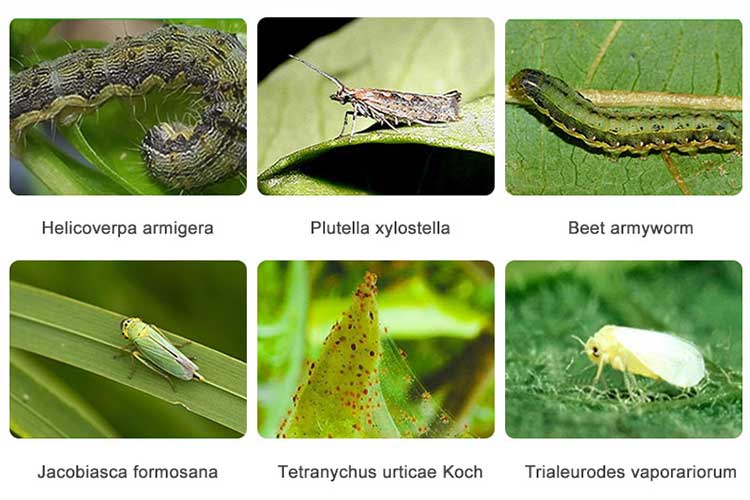
Avermectin effectively controls the following pests across crop types:
1. Insects
-
Lepidoptera (Moths and Caterpillars):
-
Diamondback moth (Plutella xylostella): A major pest of cruciferous vegetables.
-
Rice leaf roller (Cnaphalocrocis medinalis): Causes severe yield loss in paddy fields.
-
Cotton bollworm (Helicoverpa armigera): Attacks cotton, tomatoes, and maize.
-
Hemiptera (Sucking Insects):
-
Aphids (Aphis gossypii, Myzus persicae): Transmit plant viruses and sap nutrients.
-
Whiteflies (Bemisia tabaci): Damage greenhouse crops like tomatoes and cucumbers.
-
Psyllids (Diaphorina citri): Vector for citrus greening disease.
-
Diptera (Flies and Midges):
-
Leaf miners (Liriomyza spp.): Create serpentine tunnels in leaves.
-
Fruit flies (Bactrocera dorsalis): Destroy mangoes, guavas, and citrus.
2. Mites
-
Tetranychidae (Spider Mites):
-
Two-spotted spider mite (Tetranychus urticae): A polyphagous pest affecting over 200 crops.
-
Citrus red mite (Panonychus citri): Causes leaf drop in orchards.
-
Eriophyidae (Rust Mites):
-
Bud mites (Aceria sheldoni): Damage citrus buds and flowers.
3. Nematodes
-
Root-Knot Nematodes (Meloidogyne spp.):
-
Infect roots of vegetables (tomatoes, cucumbers), fruits (melons), and ornamentals.
-
Cyst Nematodes (Heterodera spp.):
Case Studies
-
Cotton Pest Management (India):
-
A 1.8% EC formulation reduced Helicoverpa armigera infestations by 90% when applied at 15 mL/acre, outperforming synthetic pyrethroids.
-
Citrus Mite Control (Spain):
Our company helps you solve agricultural problems and specializes in the production of agrochemical products such as pesticides.can be customized label bottle type, various dosage forms.
Contact Details:
WhatsApp:17733833309
E-mail:admin@hontai-biotech.com
Webside:http://www.hontai-biotech.com/
Wechat:17733833309